The regenerative student residential hall is designed to be the largest living-building housing complex on a university campus.
The unit mix of the West Residences offers a variety of living opportunities, from efficient micro-units and studio units to one-bedroom and two-bedroom apartments.
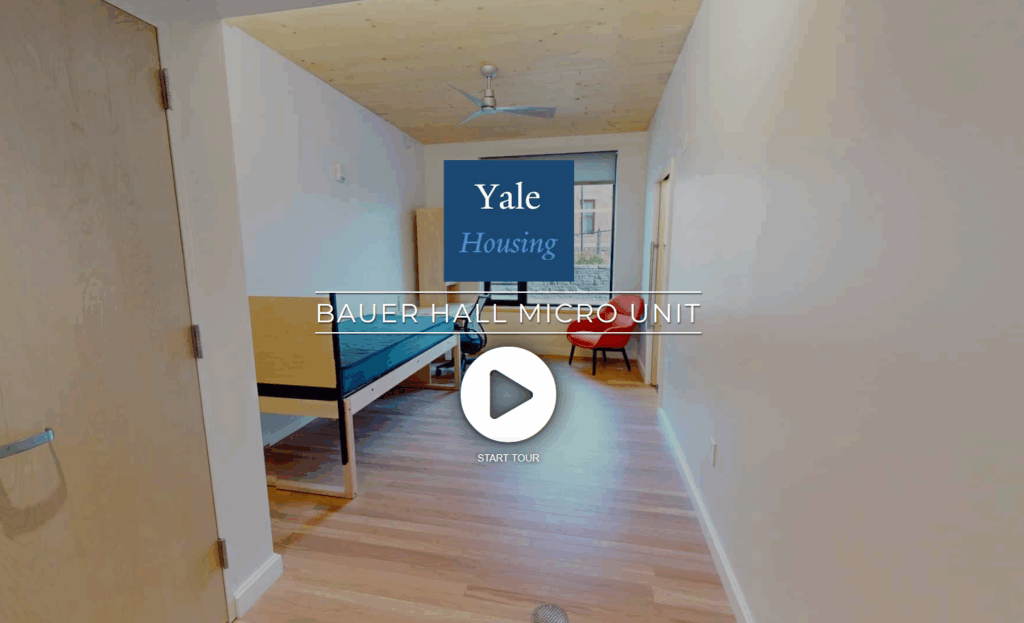
The nine micro-units have no kitchens, instead inviting residents to use the common kitchenettes in the communal hubs which also include common study centers. The micro-units are grouped together across two floors establishing intentional communities within the Living Village.
Other unit types are positioned alongside the micro-units, so as to not silo the micro-units into specific buildings or floors. Because of their location, the micro-units are at the center of the community zones within the Village.
The largest number of units are of the studio type. Two-bedroom units occupy a unique location in the base of the East Rock Terrace, where, as the site slope drops in elevation, a lower level of that building is exposed. The larger footprint will be geared toward family occupancy.
Graduate Student Housing
- 49 units / 51 beds
- 33 studio units
- 9 micro units
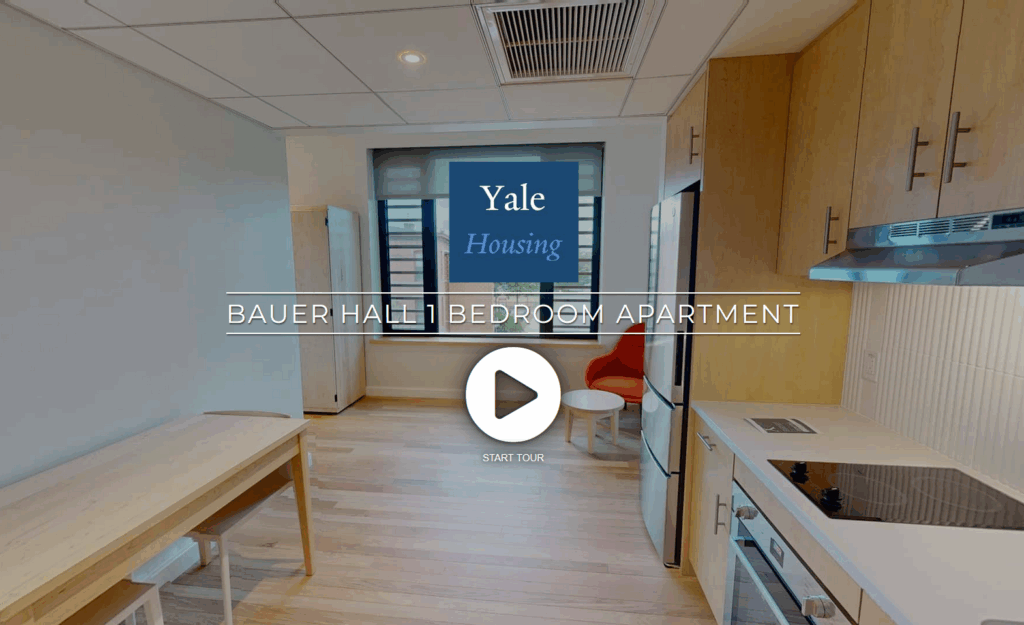
- 5 one-bedroom units
- 2 two-bedroom units
Shared Space
- Village Hub
- Community Kitchen
- Courtyard Patio
- Shared kitchenettes
- Social spaces
- Activity Center
- Lantern Lounge
- Study Centers
- Student Lounge
- Laundry facilities
Embodied Carbon
This project is being designed to meet the standards of the International Living Future Institute’s Living Building Challenge program. Program requirements regarding GHG emissions for the design include the following requirement for UEC emissions:
Carbon Storage
New projects must demonstrate a 20% reduction in the embodied carbon of primary materials compared to an equivalent baseline.
The requirements of the LBC program dictate that 80% of wood products must be sourced from Forest Stewardship Council (FSC)-certified forests and supply chains. This provision, under their “Responsible Sourcing” imperative, is designed to ensure responsible forest management practices to reduce deforestation, erosion, poor water quality, illegal logging, and other related impacts.
The LBC program allows FSC-certified wood products to claim a carbon storage benefit in the accounting of UEC for the project. The carbon mass in the wood was originally photosynthesized from the atmosphere and is kept bound in the building material throughout the material’s life span and prevented from returning to the atmosphere through decomposition or incineration. Therefore, a “negative emission” equivalent to the amount of CO2 that was photosynthesized to grow the wood mass can be applied to the accounting of UEC for the design.
Further Carbon Emission Reductions
Low-emission concrete through the use of supplementary cementitious materials to reduce the use of carbon-intensive Portland cement. We are using (GGBFS) replacing Portland cement at 40% of the binder weight. Tested strength rating matches the specification or exceed the specified strength by 1200 PSI.
- Ground granulated blast-furnace slag (GGBFS), sometimes simply referred to as “slag”, is a glassy granular material formed when molten blast-furnace slag ts rapidly chilled, as by immersion in water
- Low-emission gypsum wall board and cellulose insulation
- Terracotta – lower embodied carbon compared to aluminum, steel, glass, and concrete
- Intestor materials have a lower than industry average carbon footprint (carpet, ceiling tile, Gypsum wallboard)
- Required to purchase a minimal amount of carbon credits to offset carbon reduction requirements
Building Structures and Mechanical Systems
- Mass Timber Construction
- FSC timber beams and columns fabricated off site and light wood
framing used throughout (Forest Stewardship Council approved)
- FSC timber beams and columns fabricated off site and light wood
- Floors
- Cross Laminated Timber (CLT) fabricated off site and craned into place
- Structural Steel
- Minimal use of beams and columns in ceiling of level 1
- Foundations
- Low-emission concrete – utilizing Ground Granulated
Blast-Furnace Slag (GGBFS) at 40%, reducing the percentage use of
carbon- intensive Portland cement (see carbon emissions reduction)
- Low-emission concrete – utilizing Ground Granulated
Mechanical System Components
| SYSTEM | ASSOCIATED EQUIPMENT | OPERATIONAL TYPE | SPACE SERVED |
| Variable Refrigerant Flow System | Air source heat pumps and indoor refrigerant fan coil terminals | Heat recovery arrangement with simultaneous heating and cooling functions | All areas |
| Ventilation Air | VAV-DOAS air handling units, natural ventilation, ceiling fans, radiant heating and cooling terminals | Heat recovery, variable air volume supply/return | All areas |
Mechanical System Descriptions
All Electric Building
Variable Refrigerant Flow (VRF) HVAC systems are highly efficient electrically operated consisting o
multiple outdoor heat pump units, interior branch collector boxes with heat recovery functions and
indoor fan powered cassette air terminals for simuttaneous heating and cooling functions The air-source
VRF system is comprised of outdoor air-source heat pump units located on grade, connected via copper
refrigerant piping to individual zone indoor units thet provide heating and cooling. Outdoor units are
connected to indoor units through indoor heat recovery branch collector boxes. These units “move”
heat from one zone to another without engaging the outdoor unit compressors when simultaneous
heating and cooling is required.
Energy
The Living Village achieves a 70% reduction in total net annual energy consumption as compared to a
typical building with comparable climate, size, use, and occupancy.
- The solar roof panels and PV canopy will provide 105% of the project’s annual energy needs. The solar roof tiles are being provided by LUMA (80W, 22% efficient)
- No on-site combustion
- The project has multiple submeters to track energy used for heating, cooling, lighting, fans/pumes, plug loads, vertical transportation and domestic hot water. This will allow for study and optimization of energy use over the long term.
- Net Positive energy systems include passive design strategies and an exemplary high- performance building envelope (super insulated and tightly sealed)
- Triple glazed high performance operable windows with bird proof glass
- Individual unit temperature controls and ceiling fans
- Building facade Louvers are incorporated to shield the interior from solar heat gain. The vertical and horizontal density of the louver system is tailored on each elevation depending on the corresponding solar exposure
Interior Spaces Virtual Views


You must be logged in to post a comment.